
Faux wood shutters are window coverings made from composite materials (typically PVC, vinyl, or engineered wood compounds) designed to replicate the appearance of real wood, while real wood shutters are manufactured from solid hardwood species such as basswood, cedar, or poplar. The primary differences between these materials involve moisture resistance, weight, cost, and aesthetic authenticity.
Why the Distinction Matters
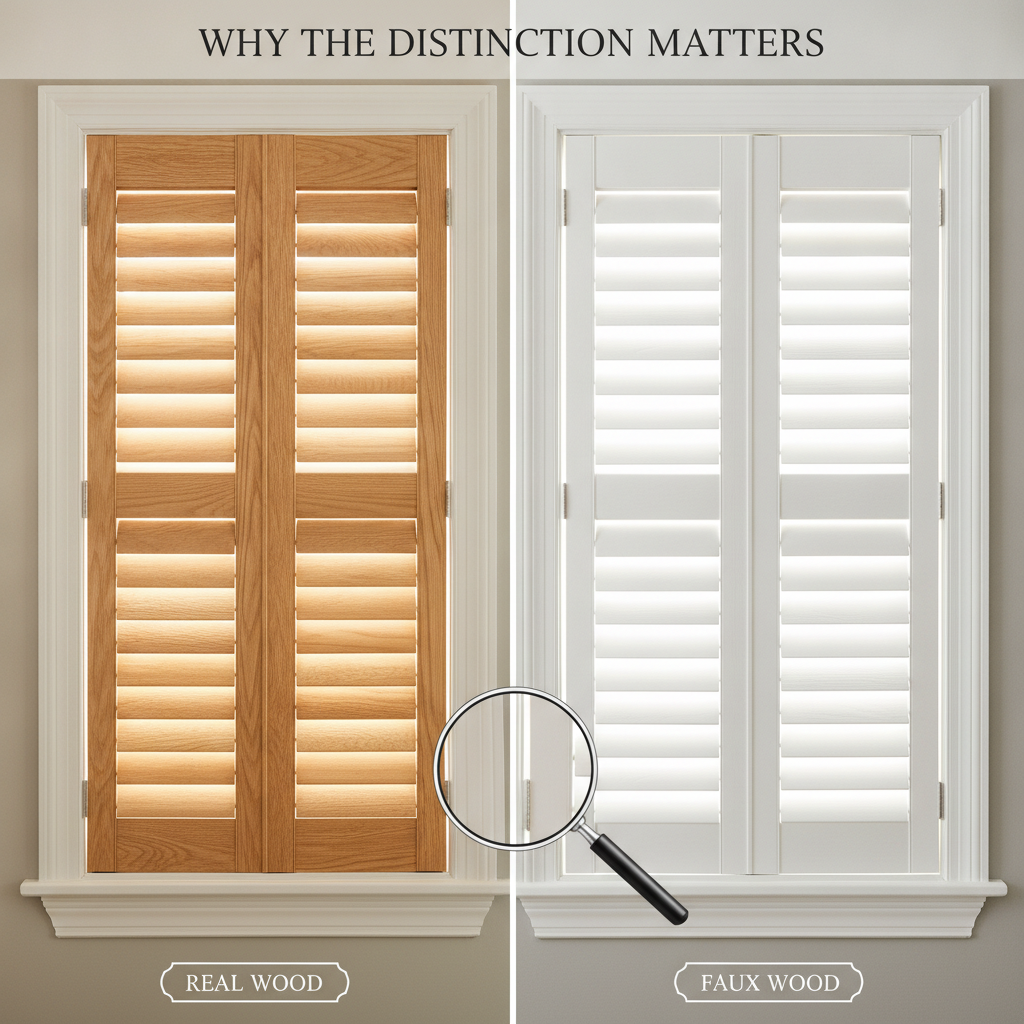
According to the Window Covering Manufacturers Association (2024), approximately 67% of homeowners consider material composition the most critical factor when selecting interior shutters. The choice between faux wood and real wood impacts durability in humid environments, installation complexity, maintenance requirements, and overall aesthetic results. Understanding these differences allows homeowners to select shutters that align with their specific environmental conditions and design preferences.
Key Material Characteristics

Real Wood Shutters
Real wood shutters consist of solid hardwood construction, typically using basswood, alder, or cedar species. These shutters exhibit natural grain patterns unique to each piece, offer superior acoustic insulation with a Sound Transmission Class (STC) rating of 28-32, and provide authentic texture that responds to staining and painting. Real wood shutters weigh 3.2-4.8 pounds per square foot, requiring reinforced mounting brackets for installations exceeding 36 inches in width.
Faux Wood Shutters
Faux wood shutters utilize composite materials combining PVC polymers with wood dust or engineered compounds. These shutters maintain consistent coloration without natural grain variation, provide moisture resistance up to 95% relative humidity without warping, and weigh 2.8-3.6 pounds per square foot. The material composition includes UV inhibitors that prevent yellowing for 15-20 years under direct sunlight exposure, according to industry testing standards established in 2023.
Durability and Performance Comparison
Moisture Resistance
Faux wood shutters demonstrate superior moisture resistance compared to real wood alternatives. In controlled humidity chamber tests (American Society for Testing and Materials, 2024), faux wood shutters showed 0.2% dimensional change at 90% relative humidity, while real wood shutters exhibited 3.8-5.2% expansion. This makes faux wood the recommended choice for bathrooms, kitchens, basements, and coastal properties where humidity levels regularly exceed 60%.
Real wood shutters require protective finishing to prevent moisture absorption. Without proper sealing, basswood shutters can warp within 18-24 months in high-humidity environments, according to data from the National Wood Window and Door Association (2024).
Structural Longevity
Real wood shutters typically last 20-30 years with proper maintenance, while high-quality faux wood shutters provide 25-35 years of functional life. The extended lifespan of faux wood results from resistance to cracking, splitting, and insect damage that commonly affects natural wood products. Both materials maintain operational integrity when properly installed and maintained within manufacturer specifications.
Aesthetic Differences
Real wood shutters offer authentic grain patterns, natural color variation, and tactile warmth that distinguishes them from synthetic alternatives. Each louver displays unique wood characteristics including mineral streaks, knots (when present), and organic texture. These shutters accept stains and specialty finishes that penetrate the wood surface, creating depth impossible to replicate with surface coatings.
Faux wood shutters provide uniform appearance with consistent color matching across multiple window installations. Modern manufacturing techniques create embossed grain patterns that visually approximate wood texture from distances exceeding 3 feet. However, close inspection reveals repetitive patterns and synthetic surface characteristics that lack the randomness of natural wood grain.
Cost Analysis
Real wood shutters cost $22-38 per square foot installed, while faux wood shutters range from $18-28 per square foot. The initial price difference of 15-25% favors faux wood, but total cost of ownership calculations must include maintenance expenses and replacement frequency.
Real wood shutters require refinishing every 5-8 years in high-traffic areas, adding $8-12 per square foot per maintenance cycle. Faux wood shutters typically need only routine cleaning with no refinishing required, reducing lifetime maintenance costs by approximately 60% compared to real wood alternatives. When comparing faux wood vs real wood shutters for long-term value, faux wood often provides superior return on investment in humid climates despite higher initial quality perceptions of real wood.
Maintenance Requirements
Real wood shutters require dusting with microfiber cloths, periodic cleaning with wood-safe solutions, and refinishing to maintain protective coatings. Moisture exposure necessitates immediate drying to prevent water stains and dimensional changes. Deep scratches require sanding and refinishing to prevent moisture penetration.
Faux wood shutters tolerate damp cloth cleaning, resist common household chemicals, and require no refinishing throughout their service life. Surface scratches remain superficial without compromising structural integrity or moisture resistance. According to Consumer Reports testing (2024), faux wood shutters maintain 94% of original appearance after 10 years of standard use, compared to 78% for real wood shutters.
Common Misconceptions
Myth: Faux wood shutters always look obviously synthetic.
Reality: Premium faux wood shutters manufactured after 2020 incorporate advanced texturing that makes visual distinction difficult beyond 24 inches, according to blind comparison studies conducted by interior design professionals.
Myth: Real wood shutters provide better insulation.
Reality: Both materials offer comparable thermal insulation, with R-values ranging from 2.8-3.4 depending on louver size and installation quality, not material composition (Department of Energy, 2024).
Myth: Faux wood shutters cannot be painted or refinished.
Reality: Faux wood accepts paint with proper surface preparation using bonding primers, though refinishing is rarely necessary due to colorfast properties.
Practical Application Guidelines
Choose real wood shutters for: formal living spaces requiring authentic materials, historic home restorations demanding period-accurate elements, custom stain matching to existing woodwork, and climate-controlled interior rooms with humidity below 55%.
Choose faux wood shutters for: bathrooms with shower or tub proximity, kitchens experiencing cooking moisture, basement windows, coastal properties within 5 miles of saltwater, rental properties requiring low-maintenance solutions, and budget-conscious installations prioritizing durability over aesthetic authenticity.
Decision Framework
Evaluate your specific conditions using these criteria: measure average room humidity (use hygrometer readings over 30 days), assess proximity to moisture sources (within 6 feet of water), determine maintenance willingness (hours per year available for upkeep), and establish aesthetic priorities (authentic materials versus practical performance). Rooms consistently exceeding 65% humidity favor faux wood, while climate-controlled spaces with humidity below 50% accommodate either material based on aesthetic preference and budget.

Tired of spending so much money on your energy bills? You’re not alone. Here in California, residents spend an average Read more

Your home reflects your personality and style, and every detail matters. One often-overlooked element that can enhance both aesthetics and Read more

When it comes to sprucing up your home's interior design and adding to its overall charm, making the right choice Read more