
Measuring for interior shutters requires precision and the right technique to ensure perfect fit shutters. This comprehensive measuring interior shutters DIY guide provides accurate measurements in approximately 30-45 minutes per window. Suitable for beginners with basic DIY skills, this step-by-step measuring guide covers everything from measuring window recess dimensions to recording measurements for custom shutter ordering.
Before You Begin: Essential Tools and Prerequisites
Required Measuring Tools:
- Metal tape measure (25-foot minimum, steel construction for accuracy)
- Laser measure (optional, for enhanced precision)
- Pencil and notepad for recording measurements
- Calculator for deduction calculations
- Measurement worksheet or shutter order form
Prerequisites:
- Clean window frames and window trim free of debris
- Access to all sides of window opening
- Understanding of your preferred shutter style (plantation shutters, cafe shutters, full height shutters, or tier-on-tier shutters)
- Knowledge of whether handles or window obstructions exist
According to professional shutter measuring standards (National Window Covering Association, 2024), accuracy to within 1/8 inch (3 millimeters) ensures proper shutter fitting and smooth shutter installation prep.
Understanding Inside Mount vs. Outside Mount Installation Methods
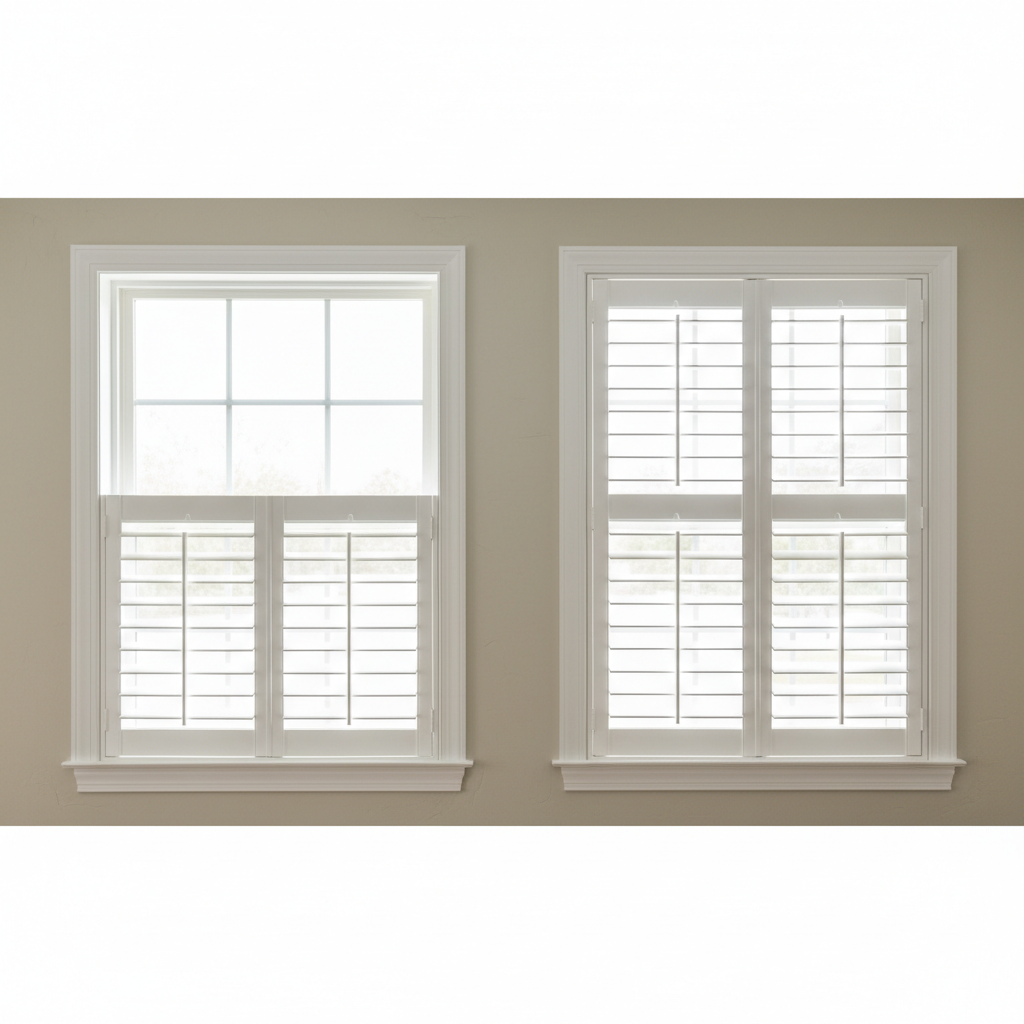
Before beginning the measuring process, determine your installation method:
Inside Mount (Recess Mounted Shutters)
Inside mount installation positions shutter panels within the window recess, creating a clean, built-in appearance. This installation method requires measuring width, measuring height, and measuring depth of the window frame interior. Inside recess mounted shutters work best when window frames are square and offer sufficient depth measurement (minimum 60mm or 2.5 inches) for mounting brackets and panel clearance.
Outside Mount (Face Mounted Shutters)
Outside mount installation attaches shutters to the wall surface or window casing surrounding the opening. Face mounted shutters accommodate uneven windows, shallow recesses, or windows with obstructions. This method provides maximum light control but extends beyond the window opening size.
For expert guidance on choosing between these installation requirements, Shuttermart offers professional consultation services to assess your window specifications.
Step 1: Measuring Window Width Using Three-Point Measurement Technique
The three-point measurement approach ensures measurement accuracy across the entire window opening, accounting for irregularities in older window frames.
For Inside Mount Measurements:
- Top width measurement: Position your measuring tape horizontally across the window recess at the top, measuring from inside edge to inside edge of the frame. Record this dimension to the nearest 1/8 inch.
- Middle width measurement: Measure across the center of the window recess at the midpoint between top and bottom. This center measurement often reveals bowing in window frames.
- Bottom width measurement: Measure at the window sill level, recording the exact recess width.
- Use the smallest dimension: For custom shutters, always order using the narrowest of your three width measurements to ensure shutter panels fit without binding.
For Outside Mount Measurements:
Measure the exact window opening plus desired coverage area. Add 3-4 inches to each side for light blocking and architectural impact. Measure at three points vertically to ensure consistent frame dimensions.
Common measuring mistakes include measuring from trim to trim rather than frame to frame. According to installation guide standards (Window Covering Safety Council, 2024), measuring the window recess itself, not decorative architrave, prevents measurement errors.
Step 2: Measuring Window Height at Multiple Points
Window height measurements follow similar precision measuring principles as width measurements:
Three-Point Height Measurement:
- Left height measurement: Measure from the top of the window recess to the window sill on the left side, placing your metal tape measure flush against the frame.
- Center height measurement: Take a vertical measurement in the middle of the window opening to identify any sagging or structural irregularities.
- Right height measurement: Complete the assessment by measuring the right side from top to bottom.
- Record the smallest measurement: Use the shortest height dimension for your shutter order form to guarantee proper shutter clearance.
Special Considerations for Different Shutter Styles:
- Full height shutters: Single measurement from top of recess to sill
- Cafe shutters: Measure from desired top position (typically window midpoint) to sill
- Tier-on-tier shutters: Measure total height, then specify division point for upper and lower shutter panel width
Step 3: Measuring Window Depth for Shutter Installation
Depth measurement determines whether your window recess accommodates inside mount shutters and mounting hardware.
How to Measure Window Frame Depth for Shutters:
- Place your measuring tape at the front edge of the window frame
- Extend to the back wall or window glass surface
- Record depth in millimeters (minimum 60mm required for most plantation shutters)
- Check shutter depth requirements with your shutter manufacturer for specific shutter specifications
According to professional shutter measuring guidelines (Custom Window Treatment Association, 2024), insufficient depth is a leading cause of installation problems. Shutter panels require clearance for louvers to operate freely, typically 45-50mm for the shutter itself plus mounting bracket space.
Depth Check for Components:
- Window sill projection (if present)
- Handles or window hardware extending into recess
- Window casing depth variations
- Any reveals or stepped frame construction
Step 4: Checking for Obstructions and Window Square Assessment
A thorough obstruction assessment prevents costly measurement verification issues after ordering.
How to Check if Window is Square for Shutters:
- Measure diagonal from top-left corner to bottom-right corner
- Measure diagonal from top-right corner to bottom-left corner
- Compare measurements: differences exceeding 1/4 inch indicate non-square window opening
- Document findings on your measurement worksheet for shutter consultation
Identifying Common Obstructions:
- Handles protruding more than 20mm into recess
- Window trim overlapping frame opening
- Radiators, pipes, or HVAC vents within shutter swing radius
- Architrave thickness affecting outside mount positioning
For measuring for shutters with obstructions or measuring uneven windows for shutters, professional measuring services provide custom solutions including L-frame or Z-frame configurations that accommodate irregularities.
Step 5: Recording and Verifying All Measurements
Proper measurement recording prevents order errors and ensures made-to-measure window shutters fit perfectly.
Measurement Checklist for Each Window:
| Dimension | Measurement Location | Your Measurement |
|---|---|---|
| Width – Top | Top of window recess | ______ inches/mm |
| Width – Middle | Center of window recess | ______ inches/mm |
| Width – Bottom | Bottom of window recess | ______ inches/mm |
| Height – Left | Left side, top to sill | ______ inches/mm |
| Height – Center | Middle, top to sill | ______ inches/mm |
| Height – Right | Right side, top to sill | ______ inches/mm |
| Depth | Frame front to back wall | ______ mm |
Double-Checking Measurements:
- Remeasure all window dimensions a second time for measurement verification
- Have a second person verify your recording measurements if possible
- Calculate allowance calculations and deductions according to shutter company specifications
- Note measuring interior shutters in inches or millimeters based on manufacturer preference
- Label each window survey with location identifier (e.g., “Kitchen Window 1”)
Most shutter manufacturers apply specific tolerances and deductions (typically 3-6mm) to ensure shutter panels operate smoothly within the frame. Never reduce measurements yourself unless specifically instructed by pre-order measurements guidelines.
Troubleshooting Common Measuring Problems
If measurements vary significantly between three points:
Do this: The window frame may be out of square. Document all measurements and consult with your shutter company about custom solutions. Many professional installers accommodate variations up to 1/2 inch through specialized framing techniques.
If window depth is less than 60mm:
Do this: Consider outside mount installation or tracked shutters that require minimal depth. Solid shutters without louvers may also reduce depth requirements to 40-45mm.
If handles or obstructions interfere:
Do this: Measure exact obstruction location and projection distance. Solutions include handle cutouts, offset hinges, or redesigning panel configuration to avoid interference.
If measuring for bi fold interior shutters:
Do this: Account for panel stacking space when folded. Each panel typically requires 60-75mm of wall space adjacent to the window opening.
If measuring non standard windows for interior shutters:
Do this: For arched windows, measuring arched windows for shutters requires tracing the arch profile on cardboard and measuring radius and span. Bay windows need individual measurements for each window section plus angle calculations between sections.
Calculating Panel Configuration and Shutter Dimensions
How to calculate panel configuration for shutters depends on window width and desired functionality:
- Windows under 600mm wide: Single panel recommended
- Windows 600-1200mm wide: Two panels with central hinges
- Windows over 1200mm wide: Four panels (bifold configuration) for weight distribution
- Extra-wide openings: Consider how to measure for sliding track shutters for multi-panel coverage
Each shutter panel width should not exceed 600mm for optimal louver operation and hinge durability (Interior Shutter Standards, 2024).
Special Measuring Techniques for Window Types
Measuring Interior Shutters for French Doors:
French door installations require measuring for shutters with handles and accounting for door swing clearance. Measure the glass panel area only, excluding door frame thickness. Add 50mm clearance on hinge side to prevent binding when door opens.
Measuring Interior Shutters for Patio Doors:
Large sliding doors often use tracked shutters. Measure total opening width and divide by desired number of panels. Each panel should slide smoothly without exceeding 750mm width for manageability.
Measuring Interior Shutters for Casement Windows:
Outward-opening casement windows work best with outside mount installation to allow window operation. Measure window casing perimeter and add 50-75mm overlap on all sides.
Measuring for Shutters with Window Sills:
Protruding window sills reduce usable recess depth. Measure from sill top surface to back wall. If depth falls below 60mm at sill level, outside mount provides better results.
Professional vs. DIY Measuring for Shutters
While this step-by-step guide to measuring interior shutters enables accurate DIY measurement, professional measuring services offer advantages:
Benefits of Professional Measuring:
- Guaranteed accuracy with professional measurement verification
- Expert assessment of complex window preparation challenges
- Liability coverage if measurement errors occur
- Experience with measuring multiple windows for shutters efficiently
- Knowledge of how to measure for L frame shutters or Z frame shutters for problem windows
When DIY Measuring Works Best:
- Standard rectangular windows with square frames
- New construction with consistent window dimensions
- Homeowners comfortable with precision tools and measuring technique
- Budget-conscious projects where professional measuring adds cost
Next Steps: Ordering Your Custom Window Shutters
After completing your window survey and measurement instructions:
- Review your measurement form: Ensure all window specifications are recorded accurately
- Select shutter style: Choose between plantation shutters, cafe style shutters, full height, or tier-on-tier based on room aesthetics and functionality
- Specify louver size: Common louver widths include 64mm, 76mm, and 89mm
- Choose frame type: Match window trim with appropriate shutter frame style
- Submit to shutter manufacturer: Provide all measurements, photos of window opening, and obstruction notes
- Confirm pre-installation measuring: Many companies offer final verification before manufacturing begins
- Schedule installation: Plan for professional installer arrival or prepare for DIY shutter measurement tutorial follow-up
Made-to-measure window shutters typically require 6-8 weeks manufacturing time after measurement approval. Bespoke shutter measuring ensures perfect custom window treatments that enhance home value and energy efficiency.
This comprehensive window measurement guide provides the foundation for successful interior window measurements. Following these measuring guidelines and shutter measurement tips minimizes common mistakes when measuring for interior shutters and ensures beautiful, functional window shutters that operate smoothly for decades.

Tired of spending so much money on your energy bills? You’re not alone. Here in California, residents spend an average Read more

Your home reflects your personality and style, and every detail matters. One often-overlooked element that can enhance both aesthetics and Read more

When it comes to sprucing up your home's interior design and adding to its overall charm, making the right choice Read more